
Perception · 5 min read
Same game. Two realities.
Why your sales team cannot see the call the way your customer does, and what a 1951 college football game proves about judging your own performance from the inside.
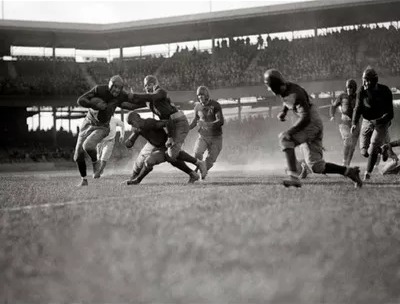
November 1951. Princeton versus Dartmouth, the last game of the season, and a notoriously rough one. Princeton’s star player, Dick Kazmaier, left the field with a broken nose. A Dartmouth player left with a broken leg. Both sides agreed on that much: it was a violent game.
Here is where it gets interesting. Weeks later, two psychologists, Hastorf and Cantril, sat down students from both schools and played them the exact same footage of the exact same game. Same film. Same sixty minutes. Same plays, frame for frame. Then they asked one question.
What did you see?
Not one Princeton student called the game clean and fair. One in three Dartmouth students did
Watching the identical film, Dartmouth students counted twice as many fouls committed by Princeton. Same evidence. Opposite conclusions.
Nobody was lying.
That is the part people miss. This was not a study about bias, or spin, or people shading the truth to protect their team. Every student in that room was giving an honest account of what they had genuinely seen. The film had not changed. Their eyes had.
Attention is selective: you see what you are primed to look for, and you miss almost everything else, with total confidence that you missed nothing at all. Which brings us to your sales team.
Same call. Two realities.
Your salesperson and your customer just sat through an identical forty-minute call. Same words, same room, same conversation. And they walked out having witnessed two completely different meetings.
What the salesperson noticed
Their own effort. The product knowledge they demonstrated. The objections they handled well. The rapport they felt building.
What the customer noticed
Whether their actual problem got solved, and whether they felt understood, or just sold to.
Neither one is lying. Both are certain their version is simply what happened.
It is not just one old study.
If that were the whole story, you could file it under interesting psychology and move on. But the same pattern shows up in real B2B sales research, independently, twenty years apart.
In one study, Brach, Walsh, Hennig-Thurau and Groth (2013) asked over 500 B2B salespeople and their customers to rate the salesperson’s customer orientation, immediately after the same sales conversation. A separate study by Brown and Chin, published in Decision Sciences in 2004, asked the same question of a different set of B2B pairs.
3.6%
Of the customer’s actual experience was explained by the salesperson’s self-rating. Brach et al., 2013.
3.5%
The same figure, from a separate set of B2B pairs, twenty years earlier. Brown and Chin, 2004.
Under 4%, in both studies. The remaining 96% or so, the part that actually determines whether the deal closes, renews, or expands, was invisible from inside the sales team.
That is not a knock on any individual salesperson’s honesty or skill. It is the Hastorf and Cantril effect, playing out in a boardroom instead of a stadium. You can be excellent at your job and still be structurally unable to see the game the way the other side is seeing it, because you are standing on the field, not in the stands.
Why the World Cup will not let a referee come from either team’s country.
FIFA does not do this to insult the players, or the coaches, or the fans. It does it because nobody, however fair-minded, can be trusted to call a foul against their own side with full objectivity. It is not a character flaw. It is a structural one.
So they bring in someone with no stake in the outcome, whose only job is to watch the same ninety minutes everyone else is watching, and call it as it actually happened.
The takeaway
B2B sales teams need a neutral referee.
Someone whose job is to look at the sales conversation through the customer’s lens rather than the seller’s, and tell you honestly what the film shows.
Not because anyone on your team is doing anything wrong. Because nobody, watching from inside the game, ever could.
Want to know what your buyers actually experienced? We ask them, and we tell you what the film shows.