
Customer journey · 6 min read
The market leader nobody wanted to marry.
Being first doesn’t earn you the right to stop asking what your customer wants.

Market leaders develop a particular kind of deafness. It isn’t arrogance, exactly. It is closer to the comfort of a couple who have been married twenty years and stopped really looking at each other over breakfast. You assume you already know what your partner wants, so you stop asking. The subscription renews. The relationship, on paper, holds.
We ran a customer journey map for a market-leading software company, a business whose scale nobody in its industry seriously disputed. Being the obvious choice, we assumed, would show up in the research as an advantage. It did not.
The first-date mistake, made after the wedding.
Here is the pattern that showed up, interview after interview: customers said the company was too busy talking about its own roadmap to hear what they actually needed. New features, technical sophistication, the next impressive release, all broadcast with real energy. Meanwhile the basic, unglamorous requests customers had been making for years sat untouched.
That is a courtship mistake. It is the business equivalent of a first date where one person will not stop describing their own achievements. The fastest way to kill interest is to talk about yourself instead of asking about the other person. Mention marriage and kids before the starter course arrives and your date is already planning their exit.
We map the buying funnel as a love story for exactly this reason: five stages, and the same rule at every one of them: ask more than you tell. Laid out side by side, the stages make the failure obvious.
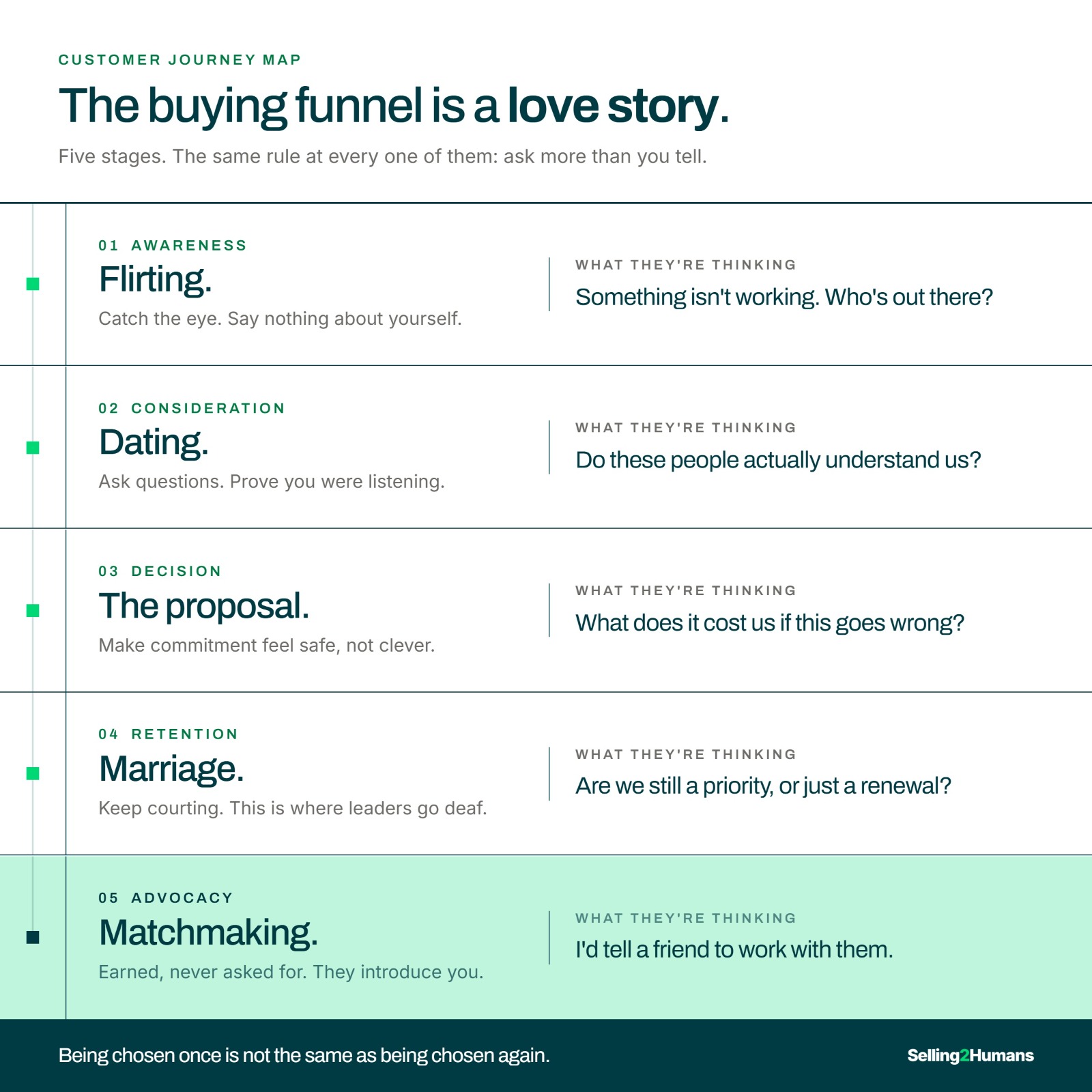
Read down the diagram and you can see where this company was living. It was still performing stage one (catching the eye, talking about itself) while its customers had long since moved to stage four, where the question is no longer “who is out there?” but “are we still a priority, or just a renewal?”. That is the mismatch. The instinct to perform your own greatness rather than listen does not go away once the contract is signed. If anything it gets worse, because nobody is actively trying to win the account anymore. Several customers used almost identical language, unprompted: they felt unseen, unheard, misunderstood, despite paying hundreds of thousands of dollars a year for the privilege.
Being chosen once doesn’t mean being chosen for good.
The second finding was quieter but just as damaging: customers did not feel like a priority. Not because anyone was rude to them, but because nobody went out of their way to prove otherwise. They knew this vendor was the market leader, and assumed, correctly in enough cases, that being one account among many meant their needs sat a little further down the list than someone else’s.
This is the marriage problem, not the dating problem. Nobody worries about being taken for granted while they are still being courted; that anxiety belongs to the phase after commitment, when the effort that won you in the first place quietly stops. Customers were not asking for grand gestures. They wanted to be treated as an equal, not as a grateful beneficiary of a supplier that no longer needed to try. The uncomfortable truth is that the company needed these customers considerably more than it let on, and pretending otherwise had cost it real trust.
The upstart with worse technology and a better marriage.
Here is the finding that actually got the room’s attention. This company was not just losing satisfaction scores. It was losing market share, and not to a rival with sharper technology. It was losing accounts to a smaller competitor that was, by every technical measure, inferior: fewer features, a thinner roadmap. Nobody disputed which platform was more advanced.
What the smaller competitor had instead was eagerness. It behaved like a company still courting, because it was. Every account still felt won rather than owned. Customers were not leaving for better technology. They were leaving for a partner who made them feel chosen.
The market leader
Superior technology, the newest capability, the most sophisticated architecture, and customers who felt like one account among many.
The smaller competitor
A thinner product, and an account team that still behaved like it had something to prove. Every customer still felt won rather than owned.
That result surprised the client more than anything else in the research. They had built their identity around technical superiority. The journey map told them customers did not rank technology first at all. Given a straight choice, they ranked partnership above it, consistently, in their own words. A smaller, hungrier competitor with a worse product was winning simply by treating people the way this company used to, back when it was still trying to be chosen.
Why you need the map, not the memory.
None of this was visible from inside the business. Ask any internal team how the relationship is going and they will answer from memory: the calls that went well, the feature launch everyone was proud of. That is like asking someone how their marriage is going and getting the highlight reel instead of the honest account. It is not dishonest. It is just structurally incapable of catching what the other side of the table is actually feeling.
A journey map forces you to go and ask directly, stage by stage, in the customer’s own words.
The only exercise that reliably catches the gap
It is the one thing we know of that surfaces the difference between the story a company tells about its relationships and the story its customers would tell, if anyone bothered to ask.
The pattern underneath all three findings is the one that ends actual marriages: talking more than you listen, and assuming the relationship holds itself together just because it once did.
The takeaway
Being the market leader gets you chosen. It does not, on its own, keep you chosen.
That still has to be earned, quarter after quarter, exactly the way it was the first time.
Look at the five stages again and ask honestly which one your account team is still behaving as though it is in.
Not sure which stage your biggest accounts think they are in? That is what a journey map is for.