
Personas · 7 min read
The pitch we lost, and the five people we finally learned to see.
Winning the room means knowing which person in it actually has the power to say yes.
A few years ago, back when I was working with a SaaS business unit, they pitched their content hosting platform to one of the biggest publishers of engineering research in the world. Everyone was pitching to them. Every major vendor in the category had a deck in the room, and the client knew it, which meant they could afford to be picky, slow, and slightly bored by all of us.
We needed something sharper than “our platform is better.” So we went back to a book that had been sitting on the shelf for a while, Scott Keyser's Winner Take All, and actually did the exercise properly. Keyser argues that inside any serious buying decision there are five distinct people, not one client. Two of them can actually sign off. Three of them can only sway the two who can.
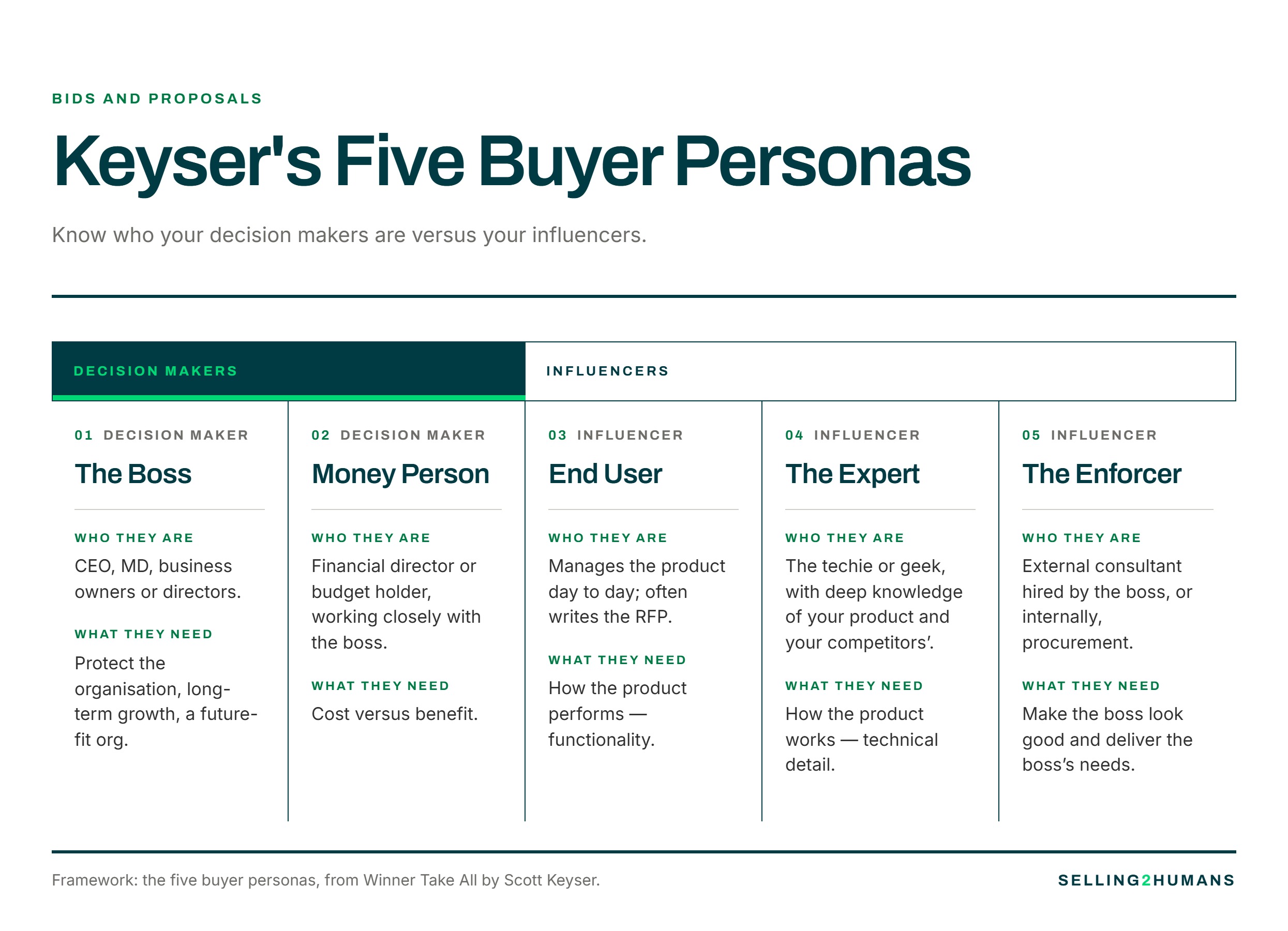
Most bidders write one pitch and aim it at all five at once. We had been doing exactly that.
Who was actually in the room.
The RFP had been written by the person managing the product day to day (the End User persona): resourcing editorial workflows, coordinating with production, worrying about conference logistics. Classic End User. Their questions were detailed, functional, and entirely reasonable. They wanted to know about uptime, features, integrations.
The problem was that the End User was not the decision-maker. The MD was. And the MD was reading none of that. He did not care about our uptime SLA. He cared about how he looked to his industry when this decision landed, and, more urgently, about a fight happening inside his own building. A faction of his board believed the organisation could build this capability internally rather than pay an outside vendor for it. That was his real obstacle, and it had nothing to do with anything written in the RFP.
We had a document to respond to, and a person to win. They were not the same task.
Playing to the love language, not the paperwork.
I call it a persona's “love language”: the thing beneath their stated corporate goal that actually moves them, and it is right there in the diagram above. For the Boss, it is rarely the metric on the slide. It is reputation. Recognition. Being seen by peers as the one who called it right.
So instead of another dense technical response, we built the MD a stage. We invited him into a series of polished, talk-show-style recorded conversations with other senior figures in the industry, the kind of content that gets shared and quoted, with his name and face attached to it. We were not selling him a platform in that moment. We were selling him the version of himself he wanted his peers to see.
Then we solved his other problem. We built him a story he could take to his own board, not a features comparison, but a case for why outsourcing this function let the organisation move faster on new technology without diluting the thing they were actually there to do: publish great research. We gave the Boss ammunition for the argument he was already having, one we had never been asked about in the RFP.
The lesson that outlasted the loss.
We lost that pitch. A competitor won it, and there is no dressing that up. But the shift in how we thought about the buyer never left the team. We had spent months treating “the client” as a single entity with one set of needs, when in reality we were negotiating with five different people, each with a different definition of winning. The RFP told us what the End User needed. It told us almost nothing about what the Boss, the Money Person, or the Enforcer behind him actually wanted to hear.
The mistake was not losing the deal. Every pitch loses sometimes. The mistake would have been walking away and blaming the product, the price, or the timeline, when the real gap was that we had answered the questions on the page instead of the questions in the room.
The takeaway
Respond to the document. Sell to the person who signs it. They are very rarely reading the same lines.
Not sure which five people are in your next pitch? That is where we start.